The nose is not merely a sensory organ — in Ayurveda it is the Shirasadvara, the direct gateway to the head and brain. Nasyam, the fourth of the five Panchakarma therapies, exploits this gateway to deliver medicated substances directly to the cranial structures, sinuses, and neurological pathways — achieving therapeutic effects that no oral or injectable route can replicate. At Nivera Ayur Care, Kochi, Nasyam is administered with classical precision as both a standalone therapy and as an integral part of our Panchakarma and neuro-rehabilitation programmes.
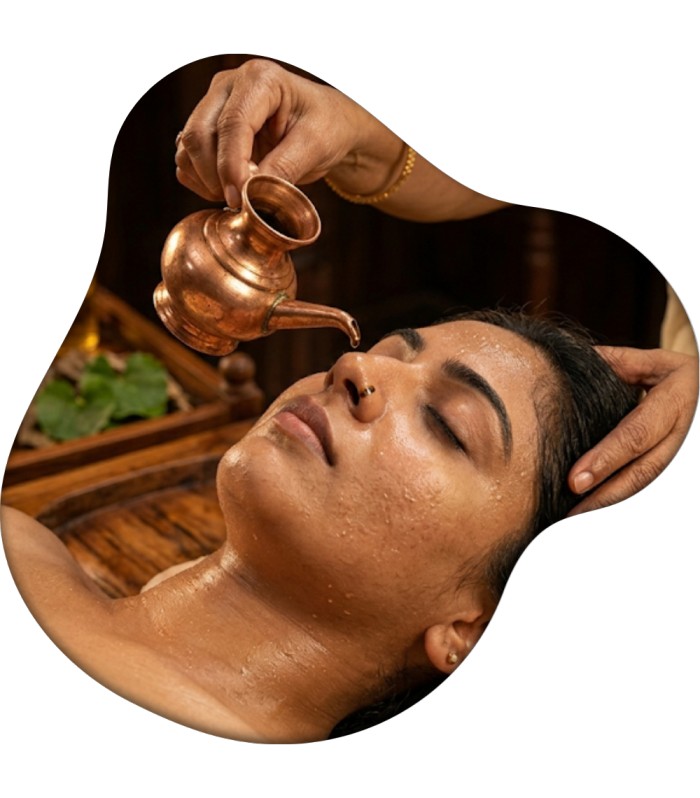
Nasyam (Nasya) is the fourth of the five classical Panchakarma therapies. It involves the therapeutic administration of medicated substances — oils, herbal juices, powders, or decoctions — through the nasal passages, from where they access the brain, cranial nerves, sinuses, and the channels of the head and neck.
Classical Ayurvedic texts state that the nose is the gateway to the head (Nasahi Shiraso Dwaram). The olfactory epithelium and nasal mucosa provide a uniquely direct route for therapeutic substances to bypass the blood-brain barrier and act on cranial structures. This is the physiological basis of Nasyam’s remarkable effectiveness for conditions of the head, brain, and upper nervous system.
Several classical types of Nasyam are described based on therapeutic intent: Shodhana Nasya (purificatory — for eliminating accumulated Kapha and Ama from the head), Shamana Nasya (palliative — for balancing Vata and Pitta), Brimhana Nasya (nourishing — for strengthening nervous tissue), Snehana Nasya (oleating — for dryness and Vata), and Virechana Nasya (cleansing — for Kapha-dominant disorders of the head).
Direct cleansing of the sinuses, nasal passages, and cranial channels (Srotas)
Significant improvement in speech disorders after stroke or neurological damage
Enhancement of cognitive function, memory retention, and mental clarity
Relief from chronic sinusitis, allergic rhinitis, and nasal polyps
Effective treatment of facial paralysis — Bell's palsy and post-stroke
Management of chronic migraines, cluster headaches, and tension headaches
Improvement in visual acuity in certain optic nerve conditions
Relief from cervical spondylosis, neck stiffness, and shoulder tension
Support for hearing improvement in certain ear conditions
Anti-ageing action — improved skin lustre, hair health, and sensory acuity
Chronic sinusitis and nasal polyps
Allergic rhinitis
Post-stroke speech and cognitive impairment
Facial paralysis — Bell's palsy
Parkinson's disease
Migraine and chronic headache disorders
Cervical spondylosis
Insomnia and anxiety
Hypothyroidism and hormonal head conditions
Premature greying, hair loss, and scalp conditions

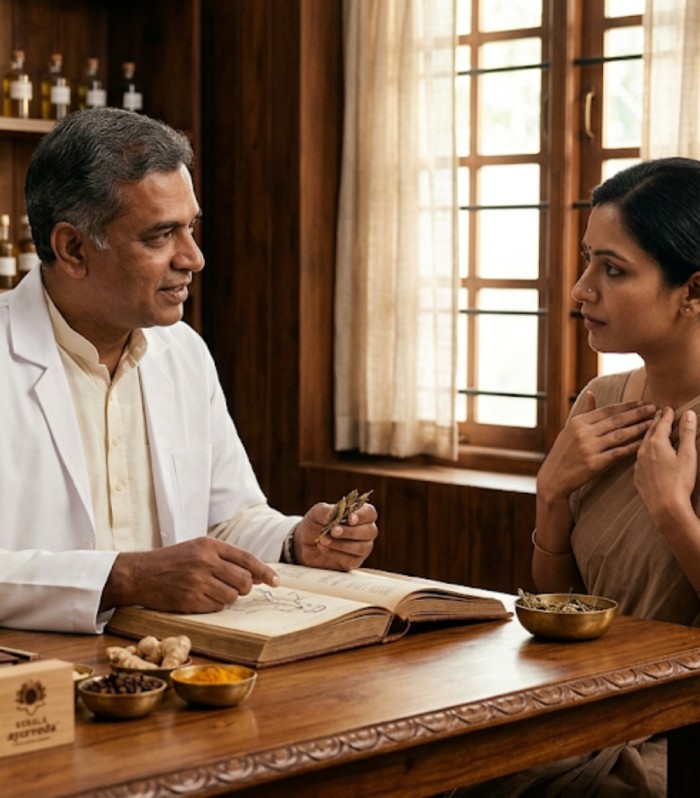
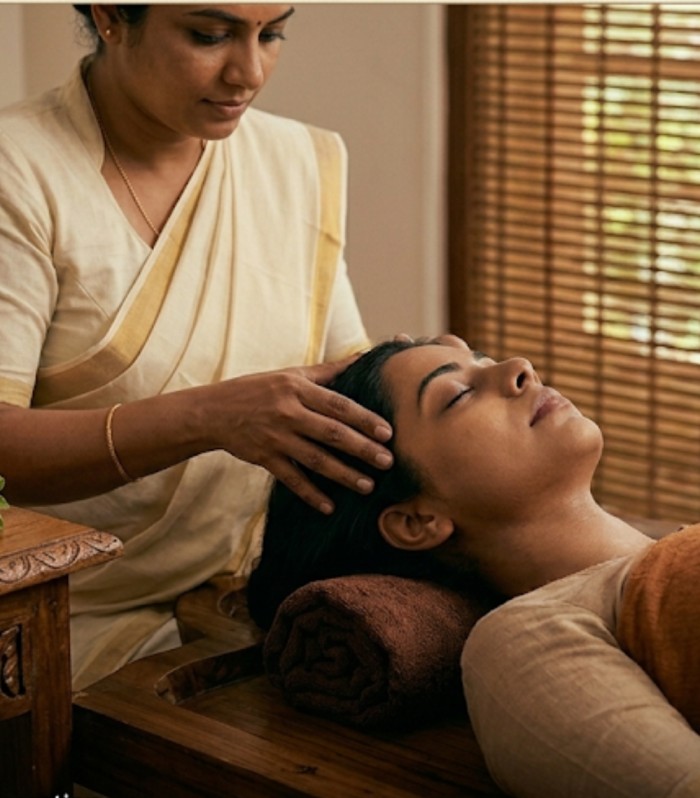
1. Face and neck massage (Mukha Abhyanga): A thorough oil massage of the face, forehead, neck, and shoulders is administered before Nasyam to open the channels and prepare the tissues.
2. Mild face and neck fomentation (Mukha Swedana): Warm steam or warm cloth application to the face and neck follows the massage — softening the nasal tissue and opening the sinus passages for optimal penetration of the medicated drops.
3. Positioning: The patient lies in a slightly reclined position with the head tilted back, exposing the nostrils — a position that is maintained comfortably throughout the administration.
After preparatory massage and steam, the patient lies in the prescribed reclined position.
The physician or trained therapist warms the prescribed medicated formulation to the appropriate temperature.
The medicated oil or preparation is administered in measured drops into each nostril — typically 6 to 8 drops per nostril for standard therapeutic Nasyam.
The patient inhales gently as the drops are administered, drawing the medicine upward through the nasal passages.
After administration, the sides of the nose, face, neck, and chest are gently massaged to support the movement of the medicine through the channels.
Any liquid that reaches the throat is spat out — the medicine should not be swallowed.
The patient rests for 15 to 30 minutes. Post-treatment, specific food, temperature, and activity guidelines are followed for the remainder of the day.
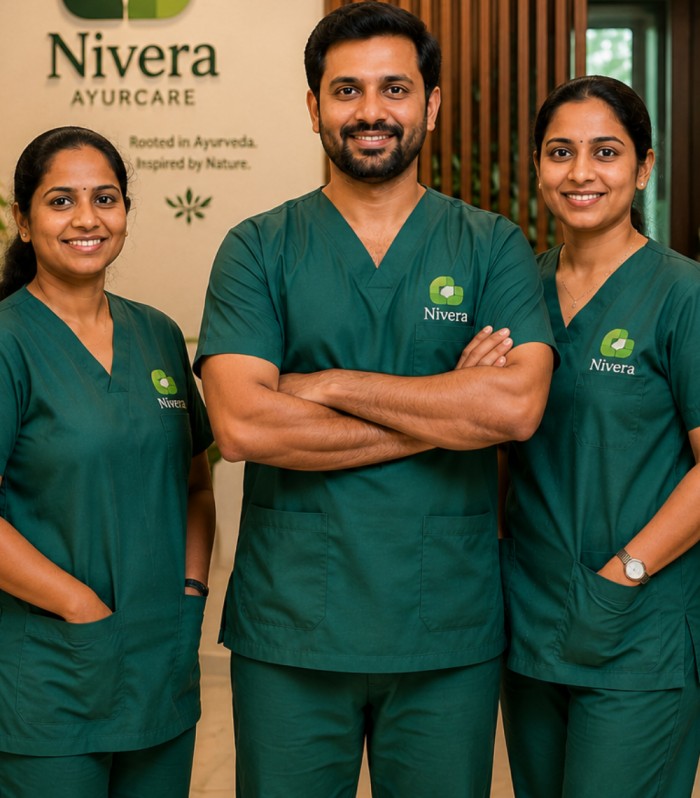
Assess properly. Plan carefully. Support patiently.
Single session: 30 to 45 minutes including preparation and rest
Standard therapeutic course: 7 consecutive days
For chronic neurological and sinus conditions: 14 to 21 consecutive days
Seasonal preventive Nasyam: 3 to 5 days twice per year (Vasanta and Sharad seasons)
Daily Nasyam (Pratimarsha Nasya) with 2 drops of plain oil can be self-administered at home as preventive Dinacharya — physician guidance recommended
Nivera Ayur Care prioritises patient safety above all. A thorough clinical assessment by our physician is mandatory before any Panchakarma procedure. NASYAM is not administered to patients with the following conditions:
During fever or acute infections
Immediately after heavy meals or fasting
During pregnancy (certain types only — physician assessment required)
In children under 7 years of age (standard Nasyam — Pratimarsha is safe)
Active nosebleeds or nasal ulcers
Directly after bathing or when the body is cold
The nasal mucosa — particularly the olfactory epithelium at the roof of the nasal cavity — is in direct contact with the cranial cavity. Medicated substances administered through the nostril can penetrate the cribriform plate (a perforated bony structure at the base of the skull) and enter the cranial environment, acting on the cerebrospinal fluid, cranial nerves, and brain structures. This is supported by modern pharmacological research into intranasal drug delivery — a finding that validates what Ayurvedic physicians have applied clinically for centuries.
Nasyam is generally comfortable and well-tolerated. Most patients experience a mild warming sensation as the oil travels through the nasal passages. Some patients have a brief episode of sneezing or watery nasal discharge during or just after the administration — this is a normal, expected cleansing response. Any sensation typically subsides within a few minutes.
For chronic sinusitis and allergic rhinitis, a minimum 7-day course of Shodhana Nasyam is recommended. Most patients notice significant improvement in congestion, breathing clarity, and headache intensity after 3 to 5 sessions. For complete, lasting relief, a 14-day course followed by preventive seasonal Nasyam produces the best long-term outcomes.
Yes — with appropriate modifications. Pratimarsha Nasya (2 drops of plain medicated oil per nostril) is safe for children as young as 3 to 5 years and is a valuable preventive for recurrent colds, allergic rhinitis, and sinus conditions. Standard Shodhana Nasyam is appropriate for children above 7 years. Our physicians adapt the type, formulation, and dose carefully for paediatric patients.
A simple, preventive form — Pratimarsha Nasya (2 drops of Anu Taila in each nostril each morning after brushing teeth) — can be safely self-administered at home as part of Dinacharya (daily Ayurvedic routine). However, therapeutic Nasyam for clinical conditions must always be prescribed and administered by a trained physician or therapist.
NASYAM at Nivera Ayur Care is offered as a physician-supervised, clinically precise programme — not a general wellness package. Every patient undergoes a thorough assessment before treatment is prescribed, ensuring that the therapy is right for you and delivered in the safest, most effective manner possible.
Take the first step toward genuine Ayurvedic healing — speak with our physicians and discover what classical Panchakarma can do for your health.
© 2026 Nivera Ayur Care. All Rights Reserved.