The Ayurvedic Understanding of ADHD
Ayurveda does not use the term ADHD — the condition was not known by that name in classical texts. However, the clinical presentation of ADHD maps closely onto concepts described in classical Ayurvedic literature, particularly under conditions of Vata and Pitta dosha aggravation affecting the mind (Manas) and nervous system (Majja Dhatu).
In Ayurvedic psychology, the mind is governed by three qualities — Sattva (clarity, balance), Rajas (activity, agitation), and Tamas (inertia, dullness). A healthy mind has predominantly Sattvic qualities — calm, focused, adaptable, and emotionally regulated. ADHD, in Ayurvedic terms, represents a state of excess Rajas in the mind — characterised by restlessness, impulsivity, distractibility, and emotional volatility — combined with aggravated Vata dosha in the nervous system channels.
The Vata-Pitta Framework for ADHD
- Vata aggravation: Vata governs all movement — including the movement of thoughts, sensory processing, and nerve impulses. Aggravated Vata in the nervous system of an ADHD child manifests as racing thoughts, inability to stay still, scattered attention, sensory sensitivity, impulsivity, and poor sleep. The Vata child moves from one activity to the next without completion, is easily overwhelmed by sensory input, and struggles to tolerate boredom or delay.
- Pitta aggravation: Pitta governs transformation and intensity. In many ADHD children — particularly those with significant emotional dysregulation, frustration intolerance, and anger outbursts — there is a significant Pitta component alongside the Vata aggravation. The Pitta-Vata ADHD child is not just restless but intensely reactive — easily frustrated, quick to anger, and difficult to redirect.
- Majja Dhatu depletion: Majja Dhatu — the nervous tissue — is considered depleted or poorly nourished in children with ADHD. When the channels nourishing the brain and nervous system are inadequately supplied, the result is impaired cognitive function, poor impulse regulation, and the characteristic inattention of ADHD. Nourishing Majja Dhatu is one of the primary therapeutic goals of Ayurvedic ADHD management.
This framework — excess Rajas, aggravated Vata and Pitta, depleted Majja Dhatu — provides a coherent therapeutic roadmap. The treatment approach aims to calm Rajas, pacify Vata and Pitta, nourish the nervous system, and create the internal conditions for sustained attention, emotional stability, and purposeful behaviour.
Ayurvedic Therapies for ADHD in Children
Ayurvedic therapies for ADHD in children are gentle, child-appropriate adaptations of classical treatments — adjusted in duration, pressure, and technique for paediatric patients. At Nivera Child Development Centre, we introduce therapies gradually, building trust with the child over the first few sessions before progressing to a full therapeutic programme. All therapies are administered by trained therapists experienced in working with neurodiverse children.
Shirodhara — The Most Powerful Calming Therapy
Shirodhara is the single most impactful Ayurvedic therapy for children with ADHD. A continuous, warm stream of medicated oil — typically Ksheerabala oil, Brahmi oil, or medicated milk — is poured in a gentle, rhythmic flow over the child’s forehead for 20 to 30 minutes (duration is adjusted based on the child’s age and tolerance).
The neurophysiological mechanism of Shirodhara is now well understood. The gentle, continuous stimulation of the forehead activates the parasympathetic nervous system — the rest-and-digest system — suppressing the hyperactive sympathetic state that drives ADHD restlessness and impulsivity. It reduces cortisol and adrenaline, increases serotonin and dopamine availability, calms Rajas in the mind, and pacifies Vata in the cranial channels.
In clinical practice at Nivera CDC, children who receive a course of Shirodhara consistently show reduced hyperactivity within the first week of treatment. Parents and teachers report improvements in the child’s ability to sit for longer periods, reduced emotional outbursts, better sleep quality, and a general sense of greater calm that carries into daily activities. For many families, Shirodhara is the single most transformative component of their child’s Ayurvedic treatment programme.
Shiroabhyanga — Medicated Head Oil Massage
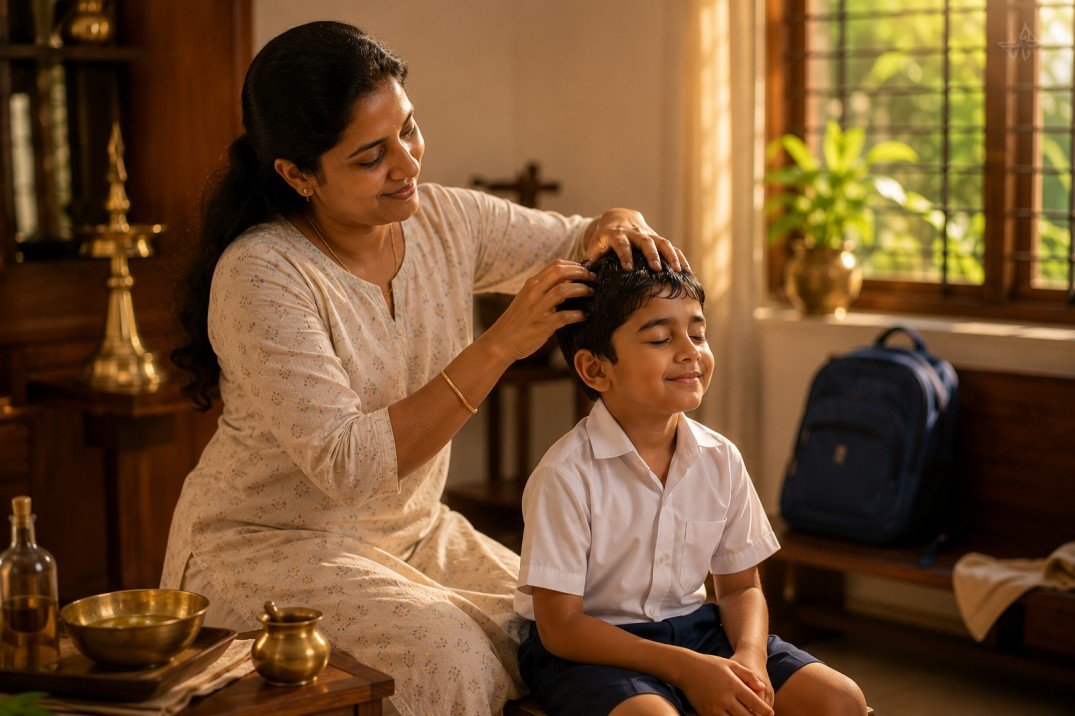
Shiroabhyanga — a deep, slow medicated oil massage of the scalp and head — is typically the first therapy introduced to ADHD children, often before Shirodhara, as it is familiar in sensation and quickly builds comfort and trust between the child and therapist. Brahmi oil, Neelibhringadi oil, or Ksheerabala oil is used, and the massage is performed with slow, firm, rhythmic circular movements that systematically stimulate the entire scalp.
The benefits for ADHD children are immediate and cumulative. Shiroabhyanga reduces cranial Vata, calms sensory processing, promotes the release of oxytocin and serotonin, and significantly improves sleep quality — particularly when performed as part of the child’s bedtime routine. Parents are taught a simplified version of Shiroabhyanga to perform at home 3 to 4 times per week, making it one of the most accessible and sustainable tools in the family’s daily ADHD management toolkit.
Full-body Abhyanga using Dhanwantharam oil or Bala oil is profoundly regulating for children with ADHD — particularly those with sensory processing difficulties, who are either hypersensitive to touch or sensory-seeking. The slow, rhythmic, whole-body oil massage provides deep proprioceptive input that calms the nervous system, reduces Vata throughout the body, and produces a state of neurological regulation that makes subsequent learning and behavioural tasks significantly more accessible.
For hyperactive children who struggle to tolerate stillness, Abhyanga is often the gateway therapy — the first experience that teaches their body what it feels like to be calm and regulated. Many children who initially resist the therapy become deeply settled within minutes, and some fall asleep during treatment — itself a significant therapeutic achievement for children whose sleep disorders are a major component of their ADHD presentation.
Nasya — Medicated Nasal Administration
Nasya involves the administration of a small quantity of medicated oil — typically Anu Taila or Brahmi Ghritam — into each nostril. In Ayurvedic anatomy, the nose is the direct gateway to the brain, and Nasya is the most direct route for delivering medicinal compounds to the cranial channels, the limbic system, and the prefrontal cortex — the brain region most specifically impaired in ADHD.
For ADHD children, Nasya improves concentration and cognitive clarity, reduces hyperactivity and impulsive behaviour, supports emotional regulation, and enhances memory and learning capacity. It is a particularly important therapy for the inattentive presentation of ADHD, where the primary deficit is in sustained attention and working memory rather than in motor hyperactivity. Nasya is administered by trained therapists and can be adapted as a gentle home practice under physician guidance.
Talam — Medicated Paste Application on the Crown
Talam involves applying a small quantity of cooling, mind-calming herbal paste — typically a combination of Brahmi, Chandana (sandalwood), and cooling oils — to the crown of the head (Brahmarandhra) and allowing it to remain for 20 to 30 minutes. This simple, non-invasive therapy has a profound calming effect on Pitta and Rajas in the mind, making it particularly valuable for ADHD children with significant anger, frustration, and emotional dysregulation. It is one of the most easily accepted therapies by young children and can be adapted as a home practice.
Navarakizhi — Nourishing the Nervous System
For children with ADHD and associated developmental delays, sensory processing disorders, or significant nervous system depletion, Navarakizhi — the medicated rice bolus therapy — provides deep nourishment to the Majja Dhatu (nervous tissue). The warm boluses of Navara rice cooked in Bala decoction and milk are applied to the child’s body in gentle, rhythmic movements, delivering potent neuro-nourishing compounds directly into the tissues. It improves proprioception, muscle tone, neurological integration, and the overall quality of the child’s sensory experience of their own body.
Ayurvedic Herbal Medicines for ADHD in Children
Internal Ayurvedic herbal medicines are among the most effective tools in ADHD management — working at the neurochemical level to balance dopamine and serotonin pathways, nourish the nervous system, reduce neurological hyperexcitability, and improve cognitive function. All medicines are prescribed in child-appropriate doses by our Ayurvedic physicians at Nivera CDC and are adjusted based on the child’s age, constitution, symptom pattern, and current treatment:
- Brahmi (Bacopa monnieri): The most important single herb for ADHD in Ayurvedic medicine. Clinical research consistently demonstrates that Brahmi improves working memory, sustained attention, processing speed, and impulse control in children. It works by enhancing dendrite branching in the hippocampus, modulating serotonin and acetylcholine pathways, and reducing cortisol. Taken as Brahmi Churna in warm milk or honey, or as standardised Brahmi extract.
- Shankhapushpi (Convolvulus pluricaulis): The premier brain tonic in Ayurveda for children. Shankhapushpi enhances cognitive function, improves memory consolidation, reduces anxiety and mental fatigue, and calms the hyperactive mind without sedation. It is particularly effective for the inattentive presentation and for children with ADHD-associated learning difficulties. Taken as Shankhapushpi Syrup or Churna.
- Ashwagandha (Withania somnifera): Ayurveda’s most powerful adaptogenic nervine. Reduces the cortisol-driven hyperarousal that worsens ADHD symptoms under stress, rebuilds depleted nervous system reserves (Ojas), improves sleep quality, and supports the development of emotional resilience. Particularly valuable for ADHD children with significant anxiety, sleep disturbance, and stress reactivity.
- Vacha (Acorus calamus): A classical Ayurvedic herb specifically indicated for speech, language, and cognitive development in children. Vacha improves neurological conduction velocity, enhances speech fluency and articulation, improves memory, and reduces the cognitive fogginess that accompanies the inattentive ADHD presentation. Used in small, carefully calibrated paediatric doses under physician supervision.
- Saraswatarishta: A classical fermented liquid formulation containing Brahmi, Shatavari, Vidanga, Vacha, and multiple other cognitive-supporting herbs. One of the most widely prescribed Ayurvedic formulations for children with ADHD, learning difficulties, and developmental delays. Improves memory, concentration, speech, and emotional stability with consistent use.
- Brahmi Ghritam: Medicated ghee prepared with Brahmi and other brain-nourishing herbs. Ghee acts as a lipid carrier that transports medicinal compounds across the blood-brain barrier directly to the neural tissue. Brahmi Ghritam is particularly valuable for nourishing depleted Majja Dhatu and improving the deep cognitive functions — working memory, attention regulation, and executive function — most impaired in ADHD.
- Medhya Rasayana (Cognitive Rejuvenation Formulas): Classical Ayurvedic texts describe four primary Medhya Rasayanas — herbs that specifically rejuvenate the intellect and cognitive function: Brahmi (Bacopa monnieri), Shankhapushpi, Guduchi (Tinospora cordifolia), and Yashtimadhu (Liquorice). A combination of these four, formulated in appropriate doses for the child’s age and constitution, forms the core of long-term Ayurvedic cognitive support for ADHD.
Ayurvedic Diet for Children With ADHD
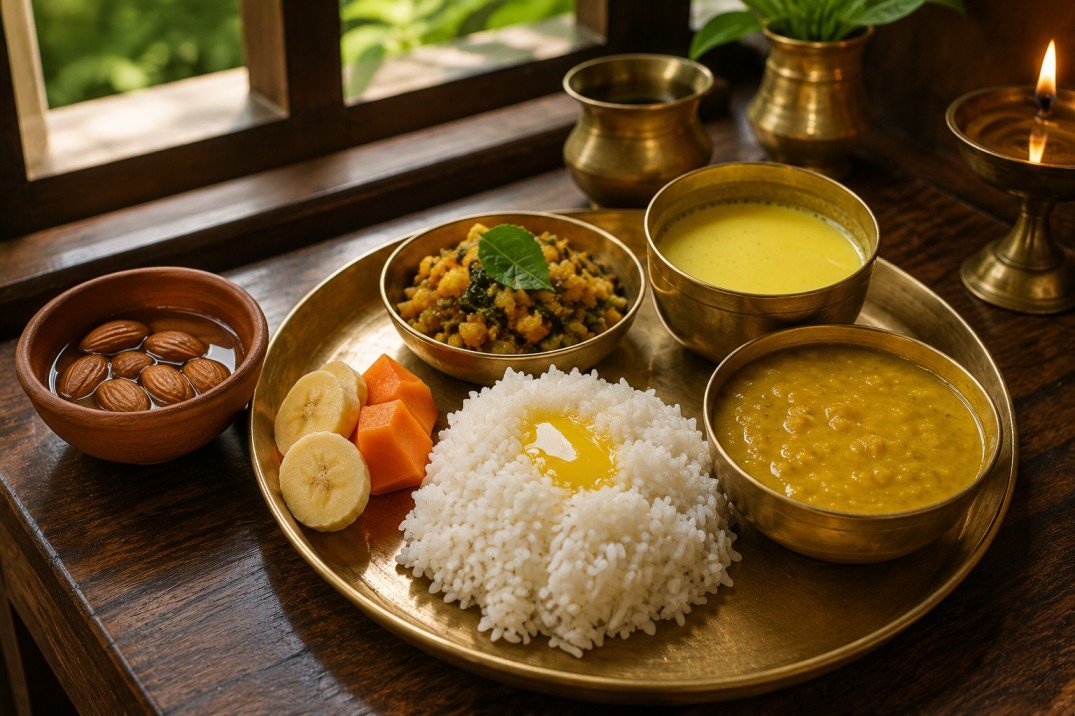
Diet is one of the most immediately impactful and most underutilised tools in ADHD management. The relationship between food and brain function is direct and powerful — what an ADHD child eats influences their neurotransmitter levels, blood sugar stability, gut microbiome, and inflammatory status, all of which directly shape their focus, behaviour, and emotional regulation throughout the day.
Foods That Support Focus and Calm
- Desi ghee daily: The most important brain food in Ayurveda. Ghee provides the essential fatty acids and fat-soluble vitamins that the developing brain requires for myelin synthesis, neurotransmitter production, and prefrontal cortex function. Add one teaspoon to warm rice, dal, or chapati at every meal.
- Warm milk with Brahmi and Ashwagandha at bedtime: The single most powerful nightly brain-nourishing practice for ADHD children. Brahmi improves sleep architecture and memory consolidation; Ashwagandha reduces cortisol and promotes deep, restorative sleep. Sweetened lightly with jaggery — never refined sugar.
- Almonds and walnuts (soaked overnight): Rich in omega-3 fatty acids, Vitamin E, and magnesium — all critical for dopamine and serotonin synthesis and prefrontal cortex function. Soak overnight to remove the tannin coating and improve digestibility. Give 5 soaked almonds and 2 walnuts every morning.
- Fresh fruits — especially pomegranate, banana, and amla: Natural sugars with fibre provide stable blood glucose — preventing the blood sugar crashes that dramatically worsen ADHD symptoms. Amla provides Vitamin C critical for dopamine synthesis.
- Warm, freshly cooked meals: Warm food is easier to digest and does not aggravate Vata — the dominant dosha in ADHD. Cold, refrigerated, and processed food weakens digestion, creates Ama, and worsens neurological imbalance.
- Sesame seeds and sesame oil in cooking: Rich in magnesium and zinc — minerals that modulate NMDA receptors and support healthy dopamine function. Magnesium deficiency is particularly common in ADHD children and directly worsens hyperactivity and impulsivity.
- Turmeric in all cooking: Anti-inflammatory and neuroprotective. Curcumin enhances Brain-Derived Neurotrophic Factor (BDNF) — a key protein for neuroplasticity and cognitive function that is reduced in ADHD. Always pair with black pepper to improve absorption.
Foods to Remove From an ADHD Child's Diet
- Refined sugar and sugary snacks: The single most damaging dietary factor for ADHD. Sugar causes rapid blood glucose spikes followed by crashes that worsen inattention, irritability, and impulsivity dramatically. Includes biscuits, candy, chocolate, soft drinks, packaged juices, and sweet breakfast cereals.
- Artificial food colours and preservatives: Tartrazine (Yellow 5), Sunset Yellow, Carmoisine, and other artificial colours have been consistently linked to increased hyperactivity and inattention in children — particularly those with ADHD — in multiple clinical studies. Remove all packaged and processed foods containing these additives.
- Cold and refrigerated food: Directly aggravates Vata and impairs Agni — reducing the quality of nutritional absorption and worsening neurological imbalance. Never give ADHD children cold drinks, ice cream, or food straight from the refrigerator.
- Excessive salty and spicy snacks: Aggravate Pitta and Rajas — worsening the emotional reactivity and frustration intolerance seen in combined-presentation ADHD. Includes chips, fried snacks, and heavily spiced fast food.
- Wheat and dairy (in sensitive children): A subset of ADHD children show significant improvement when gluten and casein are reduced or eliminated. This is not universal — but if a child’s ADHD symptoms are accompanied by chronic digestive complaints, eczema, or frequent respiratory infections, a supervised elimination trial is worth discussing with your Ayurvedic physician.
Daily Routine (Dinacharya) as a Therapeutic Tool
In Ayurveda, a consistent daily routine — Dinacharya — is considered one of the most powerful therapeutic interventions for Vata disorders, which include ADHD. The irregular, unpredictable daily schedules of many modern children are themselves a cause of Vata aggravation — and establishing structure is, in Ayurvedic terms, a direct neurological treatment.
This is not merely a philosophical position. Modern neuroscience completely validates it. The ADHD brain struggles with self-regulation — with internally generating the timing and sequencing of behaviour. An external routine provides the scaffolding that the ADHD child’s executive function cannot reliably provide internally. Consistent routines reduce the cognitive load of daily transitions, lower cortisol, and improve the predictability that an ADHD child’s nervous system craves but struggles to create independently.
- Fixed wake time daily: Wake the child at the same time every morning — including weekends. Irregular wake times disrupt the body clock and significantly worsen daytime attention and behaviour.
- Morning Shiroabhyanga before school: A 10-minute head oil massage with Brahmi oil before school produces measurable improvement in morning focus and emotional regulation. It is one of the most practical and impactful home practices families can establish.
- Warm, structured breakfast: Never send an ADHD child to school without a warm, protein-and-fat-rich breakfast. Blood sugar stability in the first 2 hours of the school day is a primary determinant of morning classroom performance.
- Unstructured outdoor play after school: Minimum 45 to 60 minutes of outdoor physical activity — ideally in a natural setting — before homework. Physical movement is one of the most powerful natural dopamine regulators available to an ADHD child.
- Screen-free evening from 7 PM: Screen use after 7 PM disrupts melatonin production, delays sleep onset, and significantly worsens the following day’s attention and behaviour. This single change produces some of the most dramatic improvements in ADHD symptom severity that families report.
- Brahmi milk and Shiroabhyanga at bedtime: Establish a consistent, calming bedtime routine ending with warm Brahmi milk and a gentle head massage. Consistent sleep onset — before 9:30 PM for school-age children — is as important as any medicine.
Ayurveda and Occupational Therapy: The Most Effective Combination
At Nivera Child Development Centre, we have observed consistently that children with ADHD achieve the best outcomes when Ayurvedic treatment is integrated with Occupational Therapy (OT) and, where appropriate, behavioural therapy and speech therapy.
Occupational Therapy for ADHD focuses on sensory integration, executive function skills, fine motor development, and the development of adaptive daily living skills. These are essential therapeutic goals — but they are achieved more rapidly and more completely when the child’s nervous system is in a regulated, receptive state.
Ayurvedic therapies — particularly Shirodhara, Abhyanga, and Navarakizhi — create precisely this state. A child whose nervous system has been calmed by Shirodhara is neurologically more available for the sensory integration work of OT. A child whose proprioceptive system has been regulated by Abhyanga engages more successfully with fine motor tasks. The two systems are not competing — they are powerfully synergistic, and the evidence from our clinical practice at Nivera CDC consistently confirms this.
We also work closely with school counsellors and special educators to ensure that the gains made in therapy translate into improved classroom functioning — because ultimately, the measure of success for every family is not what happens in the treatment room, but what happens at school, at home, and in the child’s daily life.
What Can Parents Realistically Expect?
Honesty with families is a core value at Nivera Child Development Centre. Ayurveda does not cure ADHD — ADHD is a neurodevelopmental difference, not a disease to be eradicated. What Ayurvedic management does, consistently and meaningfully, is reduce the severity and impact of ADHD symptoms — making the child’s experience of their own mind more manageable and their engagement with the world more successful.
With a consistent Ayurvedic treatment programme — therapies, medicines, diet, and routine — most ADHD children show:
- Measurable improvement in sitting tolerance and sustained attention within 4 to 6 weeks of beginning Shirodhara
- Reduced frequency and intensity of emotional outbursts and frustration episodes within 6 to 8 weeks
- Improved sleep onset and sleep quality — often the first and most dramatic change parents notice
- Better academic engagement — not necessarily academic excellence, but the ability to participate in learning without constant disruption
- Reduced anxiety and improved emotional self-awareness
- Improved appetite, digestion, and general physical wellbeing — as Vata pacification has whole-body benefits
The timeline for meaningful improvement is typically 6 to 12 weeks of consistent treatment, with ongoing maintenance therapy and home practices supporting sustained gains over months and years. Ayurvedic management works best when it is not a short-term experiment but a sustained commitment — because ADHD is a long-term condition and its management requires a long-term perspective.
A Note to Parents
Your child is not broken, and neither are you. ADHD is a different kind of brain — one that is often creative, intensely curious, deeply empathetic, and capable of remarkable focus when genuinely engaged. Ayurvedic management does not aim to make your child neurotypical. It aims to give them the neurological calm and physical health to access the best of who they already are — and to make the journey through childhood a little less exhausting for both of you