Postpartum Hair Fall:

Ayurvedic Treatment, Causes & Natural Solutions

By Nivera Ayur Care | Ayurvedic Hospital, Kochi, Kerala Medically reviewed by our Ayurvedic physicians

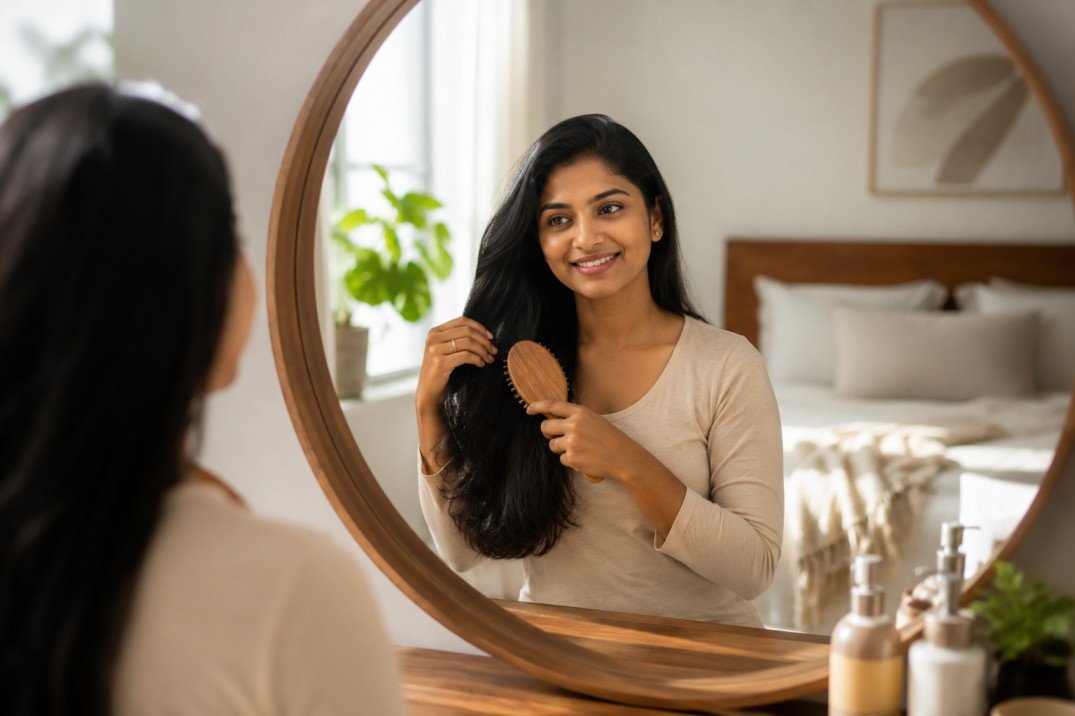
You survived nine months of pregnancy, navigated delivery, and are now caring for a newborn — and then, somewhere around Week 6 to 12 after delivery, you notice it. Clumps of hair in the shower drain. A thinner ponytail. A receding hairline. Strands on your pillow every morning.

Postpartum hair fall — medically known as postpartum telogen effluvium — is one of the most distressing but least talked about experiences of new motherhood. Up to 50 percent of women experience noticeable hair shedding after delivery, yet many feel blindsided when it happens because no one warned them about it.

The reassuring truth is this: postpartum hair fall is normal, temporary, and in most cases, completely reversible. The even better news is that Ayurveda — with its understanding of postpartum Vata aggravation and Dhatu depletion — offers one of the most effective, natural frameworks for managing and reversing this condition, often producing visible results within 6 to 8 weeks of consistent care.

This guide explains why postpartum hair fall happens, what Ayurveda says about it, and exactly what you can do — through therapies, medicines, diet, and hair care practices — to restore the health and density of your hair after delivery.
Why Does Hair Fall Happen After Delivery?

The Hormonal Science Behind Postpartum Hair Loss

To understand postpartum hair fall, you first need to understand the hair growth cycle. Hair follicles cycle continuously through three phases:

  • Anagen (Growth Phase): Active hair growth — lasts 2 to 6 years
  • Catagen (Transition Phase): Hair growth slows — lasts 2 to 3 weeks
  • Telogen (Resting/Shedding Phase): Hair rests and then falls out — lasts 2 to 3 months


During pregnancy, dramatically elevated oestrogen levels prolong the anagen (growth) phase across all your follicles simultaneously. This is why pregnant women typically enjoy thicker, lusher, more voluminous hair than usual — fewer hairs are entering the shedding phase.

After delivery — whether vaginal or caesarean — oestrogen levels drop sharply and rapidly. This sudden hormonal withdrawal triggers a mass synchronised entry of hair follicles into the telogen (resting) phase. Approximately 2 to 3 months later, all those follicles shed simultaneously, resulting in the dramatic hair fall that mothers typically notice between Weeks 6 and 16 postpartum.

This condition is called telogen effluvium — a temporary, self-limiting form of diffuse hair shedding triggered by a physiological shock, in this case the dramatic hormonal shift of childbirth.

The Ayurvedic View: Why Postpartum Hair Fall Runs Deeper Than Hormones

Modern medicine explains postpartum hair fall purely as a hormonal event. Ayurveda agrees that hormonal shifts play a role — but sees them as one expression of a much deeper underlying imbalance that begins during delivery and is compounded in the weeks that follow.

The Hormonal Science Behind Postpartum Hair Loss

Ayurvedic Root Cause

What It Means & How It Causes Hair Fall

Vata Dosha Aggravation

Delivery — especially C-section — causes extreme Vata aggravation. Aggravated Vata dries out the scalp, constricts the channels (Srotas) that nourish hair follicles, and disrupts the cellular communication needed for hair growth.

Rasa and Rakta Dhatu Depletion

Blood loss during delivery depletes Rasa Dhatu (plasma) and Rakta Dhatu (blood tissue) — the first two tissue layers in the Ayurvedic nutrition chain. Since hair (Kesha) is a byproduct of Asthi Dhatu (bone tissue), depletion of earlier Dhatus means inadequate nourishment reaches the follicles

Impaired Agni (Digestive Fire)

Sleep deprivation, stress, erratic eating habits, and the physical demands of newborn care weaken the digestive fire. Weak Agni means nutrients from food — even good food — are not properly absorbed and converted into nourishing tissue, leaving follicles starved.

This layered understanding is why Ayurvedic postpartum hair care is far more comprehensive than simply applying a hair oil. True recovery requires addressing Vata, rebuilding depleted Dhatus, restoring Agni, and nourishing the scalp from both inside and outside simultaneously.

Ayurvedic Internal Medicines for Postpartum Hair Fall

Internal Ayurvedic medicines work at the root level — they rebuild depleted Dhatus, restore hormonal balance, strengthen the nervous system, and improve nutrient absorption. All the following should be taken only under the guidance of a qualified Ayurvedic physician, as dosage and combinations depend on individual assessment:

Medicine / Herb

How It Helps Postpartum Hair Fall

Shatavari (Asparagus racemosus)

The most important herb for postpartum recovery. Restores oestrogen balance, rebuilds Rasa and Rakta Dhatu, supports lactation, and nourishes hair follicles at the tissue level. Taken as Shatavari Kalpa in warm milk.

Ashwagandha (Withania somnifera)

Adaptogenic nerve tonic that reduces cortisol — a major driver of telogen effluvium. Rebuilds Ojas (vital energy) and supports overall recovery from postpartum depletion.

Brahmi (Bacopa monnieri)

Nourishes the nervous system and scalp channels. Reduces postpartum anxiety, improves sleep quality, and supports healthy hair follicle function through Vata pacification

Bhringraj (Eclipta alba)

Classically called the 'king of hair herbs' in Ayurveda. Directly stimulates hair follicle growth, darkens premature greying triggered by postpartum stress, and reduces scalp inflammation.

Amalaki (Indian Gooseberry / Amla)

Richest natural source of Vitamin C — a critical co-factor for collagen and keratin synthesis. Rebuilds hair shaft strength and reduces breakage. Taken as Chyawanaprash or fresh Amla juice.

Dashamoola Kashayam

Classical Vata-pacifying decoction. Reduces systemic Vata aggravation, improves peripheral circulation to the scalp, and supports overall postpartum recovery.

Ashokarishta

Supports uterine recovery and hormonal rebalancing — addressing the root hormonal disruption that triggers postpartum hair fall.

Narasimha Rasayana

Classical Ayurvedic Rasayana specifically formulated for hair growth, nourishment, and blackening. Directly targets Kesha Dhatu (hair tissue).

Ayurvedic External Therapies for Postpartum Hair Fall

1. Shiroabhyanga — Medicated Head Oil Massage

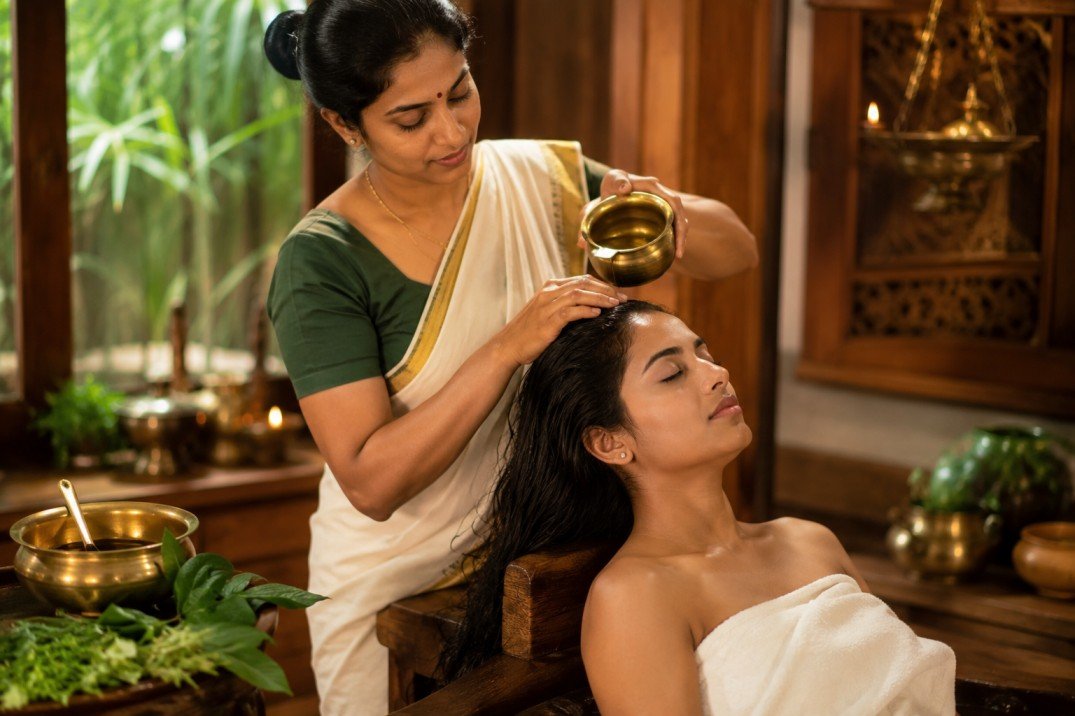
Shiroabhyanga is the cornerstone of Ayurvedic hair and scalp care. In the postpartum context, a warm medicated oil is massaged into the scalp using specific circular movements that stimulate the hair follicles, improve scalp circulation, reduce Vata in the head, and calm the nervous system.

Recommended oils for postpartum hair fall:

  • Bhringraj oil — the most effective for hair fall and regrowth stimulation
  • Ksheerabala oil — deeply nourishing; calms Vata and reduces postpartum anxiety alongside hair fall
  • Neelibhringadi oil — classical Kerala formulation specifically for hair growth and scalp health
  • Brahmi oil — strengthens the nervous system; reduces stress-driven hair fall

How to do Shiroabhyanga at home: Warm the oil gently (not hot), part the hair in sections, and apply to the scalp using the pads of the fingertips in slow, firm circular movements for 15 to 20 minutes. Leave on for at least 30 minutes before washing — overnight application is ideal for maximum absorption.

2. Shirodhara — Continuous Oil Stream Therapy

Shiroabhyanga is the cornerstone of Ayurvedic hair and scalp care. In the postpartum context, a warm medicated oil is massaged into the scalp using specific circular movements that stimulate the hair follicles, improve scalp circulation, reduce Vata in the head, and calm the nervous system.

Recommended oils for postpartum hair fall:

  • Bhringraj oil — the most effective for hair fall and regrowth stimulation
  • Ksheerabala oil — deeply nourishing; calms Vata and reduces postpartum anxiety alongside hair fall
  • Neelibhringadi oil — classical Kerala formulation specifically for hair growth and scalp health
  • Brahmi oil — strengthens the nervous system; reduces stress-driven hair fall

How to do Shiroabhyanga at home: Warm the oil gently (not hot), part the hair in sections, and apply to the scalp using the pads of the fingertips in slow, firm circular movements for 15 to 20 minutes. Leave on for at least 30 minutes before washing — overnight application is ideal for maximum absorption.

3. Nasya (Medicated Nasal Administration)

Nasya involves the administration of medicated oil or herbal preparations through the nostrils. In Ayurveda, the nose is considered the gateway to the brain and the channels of the head. Anu Taila Nasya — a classical formulation — nourishes the cranial channels, reduces Vata in the head, and improves nutrient delivery to the scalp and hair follicles. A course of 7 consecutive days of Nasya is standard, typically administered in the morning after Shiroabhyanga.

4. Navarakizhi (Medicated Rice Bundle Therapy)

While primarily used for body and nerve conditions, Navarakizhi applied to the scalp — a variant called Shiro Navarakizhi — provides deep nourishment to the hair follicles and scalp tissue. The warm boluses of Navara rice cooked in herbal decoction and milk deliver essential amino acids, minerals, and medicinal compounds directly to the scalp, stimulating dormant follicles and supporting new hair growth.

5. Takradhara (Medicated Buttermilk Pouring)

Takradhara involves pouring medicated buttermilk (Takra) infused with Ayurvedic herbs over the scalp. This cooling therapy is particularly beneficial for postpartum hair fall with associated scalp inflammation, dandruff, or excessive scalp heat — conditions that worsen in the Kerala climate. It balances Pitta in the scalp, reduces inflammation, and creates an optimal environment for follicle recovery.

Therapy

Primary Benefit for Postpartum Hair Fall

Shiroabhyanga

Stimulates follicles, improves scalp circulation, reduces Vata in the head

Reduces cortisol and stress-driven shedding; nourishes follicles; restores sleep

Nasya Nourishes cranial channels; improves nutrient delivery to scalp

Shiro Navarakizhi

Deep follicle nourishment; stimulates dormant hair follicles

Takradhara

Reduces scalp inflammation and Pitta; ideal for inflammatory hair fall with dandruff

Ayurvedic Diet for Postpartum Hair Regrowth

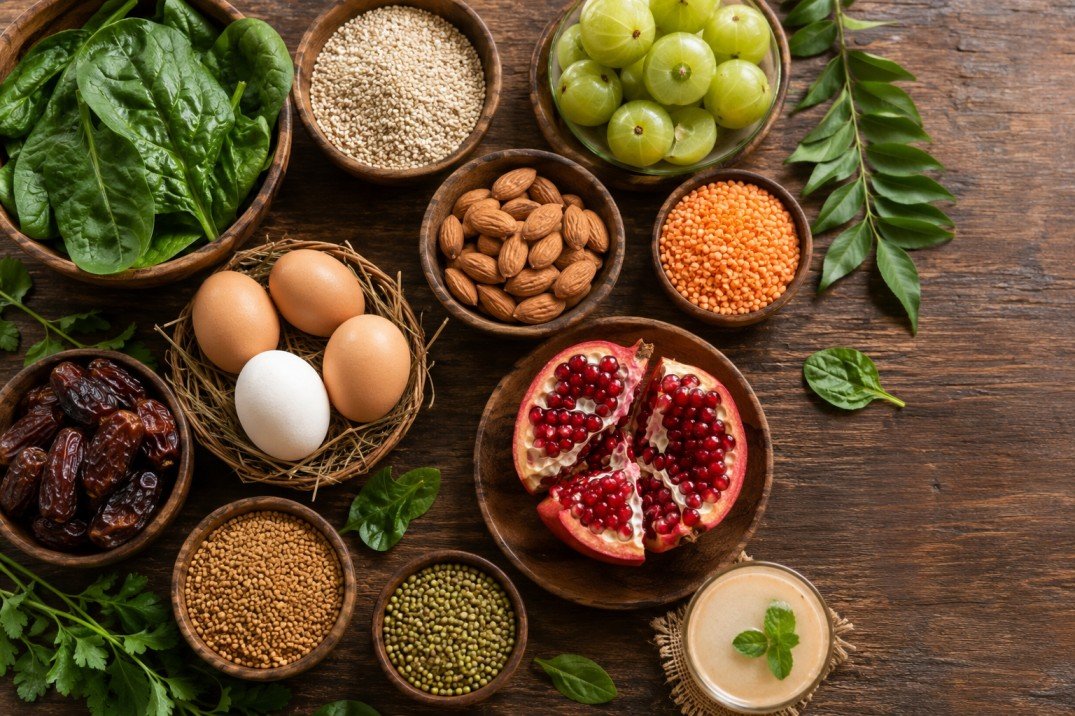
What you eat in the postpartum period is the most powerful determinant of hair regrowth — more so than any topical treatment. Hair is composed primarily of keratin protein, and its growth depends on a continuous supply of protein, iron, zinc, Vitamin C, Vitamin D, omega-3 fatty acids, and B vitamins. Ayurveda provides specific food guidance that covers all of these while simultaneously pacifying Vata and rebuilding depleted Dhatus.

Food / Ingredient

Nutrient Benefit for Hair Regrowth

Desi ghee daily

Fat-soluble vitamins A, D, E, K — essential for scalp health and hair shaft integrity; pacifies Vata

Drumstick leaves (Muringakka)

Exceptionally rich in iron, calcium, and Vitamin C — the most hair-supportive vegetable in Kerala cuisine

Sesame seeds (Ellu)

Rich in zinc, calcium, and iron; warm and Vata-pacifying; directly nourish Asthi Dhatu (bone/hair tissue)

Amla (Indian gooseberry)

Highest natural Vitamin C source; critical for keratin and collagen synthesis; take fresh, as chutney or Chyawanaprash

Warm milk with Shatavari and Ashwagandha)

Complete nerve and Dhatu tonic; rebuilds hormonal balance and follicle nourishment

Methi seeds (Fenugreek)

Rich in folic acid, iron, Vitamins A and C; both consume and apply as paste for double benefit

Cooked lentils and moong dal

Bioavailable plant protein and iron; essential building blocks of keratin

Walnuts and flaxseeds

Omega-3 fatty acids reduce scalp inflammation and support follicle membrane health

Beetroot and pomegranate

Rebuild Rakta Dhatu (blood tissue); improve scalp oxygenation and iron levels

Coconut milk and tender coconut water

Hydrates the scalp; provides electrolytes lost during delivery; supports Vata pacification in Kerala climate

Avoid

Why It Worsens Hair Fall

Cold, raw, and refrigerated foods

Cold, raw, and refrigerated foods Aggravate Vata; impair Agni and reduce nutrient absorption from food

Processed and packaged snacks

Processed and packaged snacks Devoid of nutrition; inflammatory; deplete Ojas and Dhatu quality

Excessive caffeine (tea/coffee)

Interferes with iron absorption; dehydrates the scalp; disrupts sleep and stress hormones

Crash dieting or skipping meals

Starves hair follicles of protein and micronutrients needed for anagen phase re-entry

Refined sugar in excess

Spikes cortisol; promotes inflammation; directly linked to increased telogen effluvium

Carbonated and cold drinks

Weaken Agni; impair digestive absorption of hair-supportive nutrients

Does C-Section Cause More Hair Fall Than Vaginal Delivery?

This is one of the most common questions our patients at Nivera Ayur Care ask. The honest answer is: yes, in many cases, C-section mothers do experience more severe or prolonged postpartum hair fall — and Ayurveda explains exactly why.

C-section mothers should not wait for hair fall to begin before seeking Ayurvedic postnatal care. Starting Prasavaraksha — the complete Ayurvedic postnatal programme — from the first week after delivery is the most effective way to prevent severe postpartum hair fall before it occurs.

Practical Home Hair Care for Postpartum Mothers

  • An initial consultation and Prakriti (body constitution) assessment with our Ayurvedic physician
  • A personalized therapy plan — typically combining Vasti, Kizhi, and Pizhichil based on your specific pain pattern
  • Daily monitoring and adjustments as your body responds to treatment
  • Dietary and lifestyle guidance to support recovery and prevent recurrence

Every program is tailored individually — there’s no fixed package that suits everyone, which is why a proper physician consultation always comes first.

Daily Scalp Oil Routine

  • Oil the scalp with Bhringraj or Neelibhringadi oil at least 3 times per week — daily is ideal
  • Warm the oil before application to improve absorption and blood flow
  • Massage gently with fingertip circles for 15 to 20 minutes — do not scratch or tug
  • Leave oil on for minimum 30 minutes; overnight is optimal
  • Wash with a mild, sulphate-free or herbal shampoo — avoid harsh chemical shampoos that strip the scalp

Washing and Styling

  • Wash hair with lukewarm water only — never cold water, which constricts scalp capillaries
  • Do not wash hair more than 3 times per week during the heavy shedding phase
  • Pat hair dry gently with a soft cotton towel — never rub vigorously
  • Avoid heat styling tools — blow dryers, straighteners, and curlers increase breakage of already fragile postpartum hair
  • Avoid tight hairstyles (tight buns, ponytails, braids) that create traction on the roots during the shedding phase
  • Use a wide-toothed wooden comb, not plastic fine-tooth combs, to detangle

Sleep and Stress — The Most Underrated Factors

  • Wash hair with lukewarm water only — never cold water, which constricts scalp capillaries
  • Do not wash hair more than 3 times per week during the heavy shedding phase
  • Pat hair dry gently with a soft cotton towel — never rub vigorously
  • Avoid heat styling tools — blow dryers, straighteners, and curlers increase breakage of already fragile postpartum hair
  • Avoid tight hairstyles (tight buns, ponytails, braids) that create traction on the roots during the shedding phase
  • Use a wide-toothed wooden comb, not plastic fine-tooth combs, to detangle

What to Expect: A Realistic Ayurvedic Recovery Timeline

Timeframe

What Happens & What You Should Be Doing

Week 1–4 Postpartum

Begin Shiroabhyanga at home. Start Prasavaraksha if you have not already. Focus on diet — ghee, drumstick, sesame, Amla daily.

Week 4–8 Postpartum

Hair shedding typically peaks. This is normal. Continue oil massage consistently. Begin herbal medicines under Ayurvedic supervision.

Week 8–16 Postpartum

Shedding slows. First signs of regrowth appear — fine baby hairs at the hairline and temples. Continue all practices without interruption.

Month 4–6 Postpartum

Visible improvement in hair density for most mothers. Full Panchakarma or Shirodhara course ideally completed in this window.

Month 6–12 Postpartum

Full hair volume should be restored with consistent Ayurvedic care. If significant hair fall continues beyond this point, seek re-evaluation for thyroid or nutritional deficiency.

Frequently Asked Questions

Postpartum hair fall typically begins between 6 and 12 weeks after delivery, peaks around 3 to 4 months postpartum, and naturally resolves by 6 to 12 months. With Ayurvedic intervention — including Shiroabhyanga, internal medicines, and a hair-supportive diet — most mothers see significant improvement within 6 to 8 weeks of starting care.

Yes. Regular hair fall is usually gradual and linked to factors like nutrition, stress, or scalp conditions. Postpartum hair fall is a sudden, diffuse, synchronised shedding triggered by the sharp drop in oestrogen after delivery. It is self-limiting in nature, meaning the follicles are not permanently damaged — they are simply resting. Ayurvedic care shortens this resting phase and accelerates regrowth.

Yes. Bhringraj oil applied topically to the scalp is safe during breastfeeding, as it is not ingested. Topical application does not affect breast milk composition. Internal Bhringraj supplements, however, should be taken only after consulting your Ayurvedic physician to confirm they are appropriate for your specific condition and breastfeeding status.

In the vast majority of cases, yes — completely. Postpartum telogen effluvium is a temporary condition. The follicles are intact and capable of resuming normal growth. With proper Ayurvedic care — including internal medicines, Shiroabhyanga, and a nourishing diet — full hair density typically returns within 6 to 12 months of delivery.

Yes, significantly. Shirodhara addresses postpartum hair fall on two levels simultaneously: it reduces the cortisol and stress-driven component of telogen effluvium while directly nourishing the scalp and follicles with warm medicated oil. Mothers who undergo a Shirodhara course during the postpartum period consistently report both improved sleep and reduced hair fall within 2 to 3 weeks.

Yes. Nivera Ayur Care, based in Kochi, offers a comprehensive postpartum hair care programme as part of our Prasavaraksha postnatal care services. This includes personalised Shiroabhyanga, Shirodhara, Nasya therapy, internal herbal medicines, and dietary guidance — all designed specifically for new mothers at every stage of postpartum recovery.

Your Hair Will Come Back — With the Right Care

Postpartum hair fall is one of the most emotionally impactful but least discussed aspects of new motherhood. Watching your hair thin while simultaneously managing sleep deprivation, breastfeeding, and recovery from delivery can feel overwhelming. But it is important to hold onto this truth: your follicles are not gone, and this is not permanent.

Ayurveda offers something modern medicine alone cannot — a complete system for rebuilding the depleted mother from the inside out. By addressing the root Vata imbalance, restoring the depleted Dhatus, nourishing the scalp with targeted therapies, and supporting hormonal rebalancing with classical herbal medicines, Ayurvedic postpartum care does not just stop hair fall — it restores vitality.

The earlier you begin, the faster and more complete your recovery will be. Do not wait until the shedding becomes severe. Start with oil, start with food, and start with a consultation — because your health matters as much as your newborn’s.

Worried about postpartum hair fall? Let's create your recovery plan.

At Nivera Ayur Care, Kochi, our Ayurvedic physicians design personalised postpartum hair care programmes that address the root cause of your hair fall — not just the symptoms. From Shiroabhyanga and Shirodhara to tailored herbal medicines and diet plans, we provide complete, compassionate postnatal care for every new mother.

Medical Disclaimer

This article is for informational purposes only and does not constitute medical advice. All Ayurvedic therapies, herbal medicines, and dietary recommendations mentioned should be undertaken only under the supervision of a qualified Ayurvedic physician. If you are experiencing hair fall that does not improve within 12 months postpartum, or if you have symptoms suggesting thyroid disorder or nutritional deficiency, please consult a medical professional.

Enquiry

Get Consultation With Our Experts

Nivera Ayur Care is a specialized Ayurveda hospital focused on child development care, neurological rehabilitation, women’s wellness, and holistic healing through authentic Ayurvedic therapies. We combine traditional Ayurvedic wisdom with personalized rehabilitation approaches to support long-term health and recovery

Specialized Ayurveda Care for Growth, Recovery & Wellness

Contact

© 2026 Nivera Ayur Care. All Rights Reserved.